
Building a successful organic search presence used to follow a predictable formula. You found a high-volume search term, wrote an isolated piece of content targeting that exact phrase, and built a few backlinks to it.
Today, search engines use advanced semantic models to evaluate entire subject ecosystems rather than matching standalone phrases. If you want your business to achieve sustainable visibility, you cannot rely on scattered articles. You need a unified blueprint.
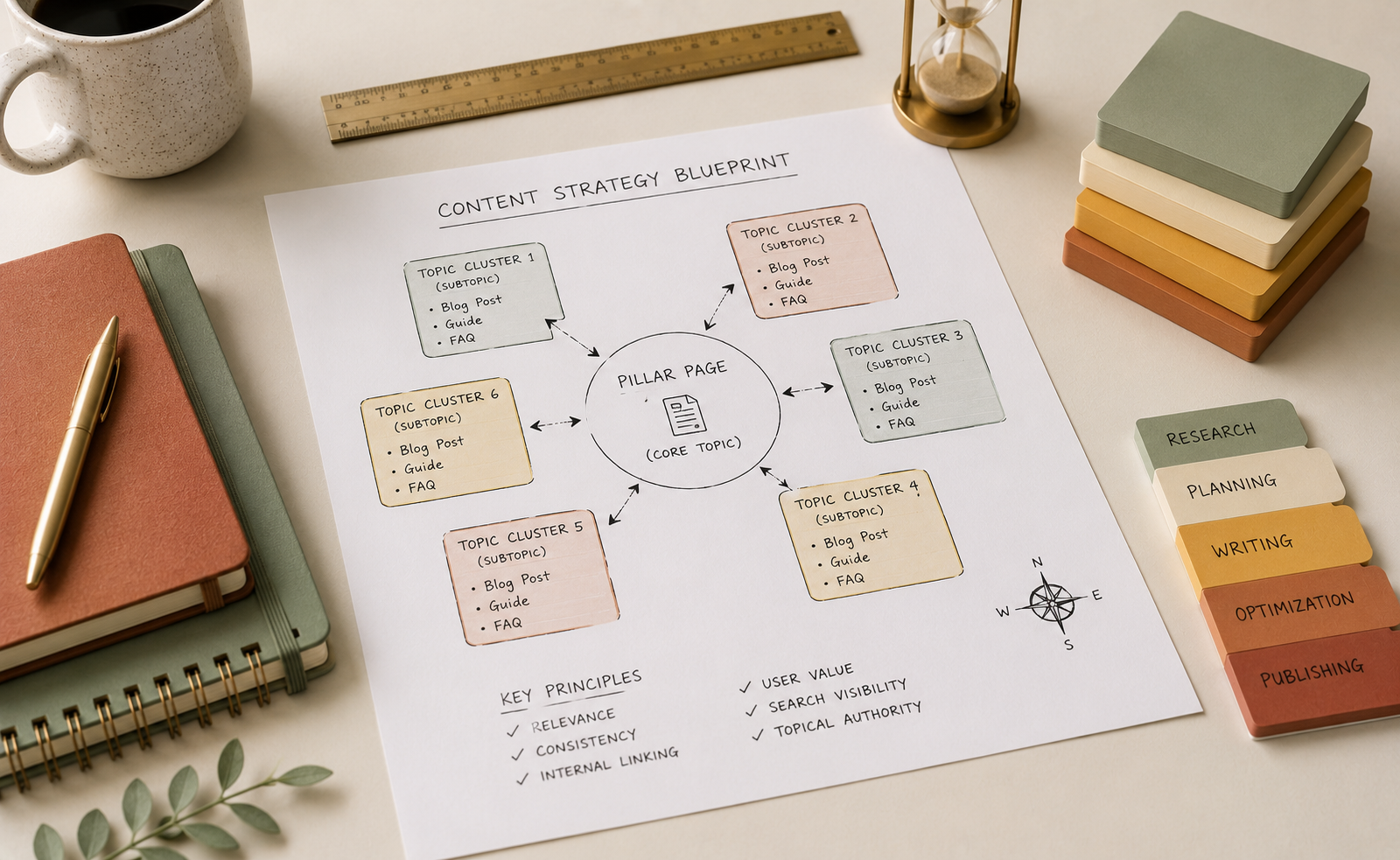
A modern SEO content strategy is about establishing complete topical authority by organizing your insights into comprehensive structural pillars. Here is how to build a scalable content engine that satisfies both human readers and search algorithms.
1. Shift from Keywords to Topical Hubs
The foundation of a high-yielding strategy requires moving away from flat spreadsheet lists. Instead, your goal is to own entire topics. When search engines recognize that your site thoroughly answers every peripheral question around a core subject, your baseline rankings across all related terms increase.
Start by identifying your core commercial pillars—the main solutions your business provides. From there, brainstorm the educational, transactional, and informational subtopics your audience searches for during their buying journey.
Instead of guessing how these pieces fit together, leveraging an advanced keyword grouping tool allows you to see exactly how search engines associate different intents. This mathematical approach to grouping ensures you map out your content hubs based on real search behavior rather than internal assumptions.
2. Cluster Content to Prevent Cannibalization
One of the most common pitfalls for growing marketing teams is keyword cannibalization. This happens when multiple articles on your site inadvertently target the same search intent, forcing search engines to guess which page to rank. Consequently, your pages end up competing against one another, diluting your overall authority.
To eliminate this friction, every piece of content must have a single, distinct job. Grouping your search terms into tightly knit clusters ensures that you write exactly one definitive resource for each distinct user intent.
Using an automated keyword clustering tool streamlines this architectural planning. It analyzes live search engine results pages to determine if phrases can be targeted together in a single article or if they require separate, dedicated pages.
3. Match the Real Search Intent
Before writing a single sentence, look at who is currently winning page one. Search intent generally falls into four main buckets:
- Informational: The user is looking for an answer or a guide.
- Navigational: The user is trying to find a specific brand or login page.
- Commercial: The user is investigating options, reading listicles, and comparing reviews.
- Transactional: The user is ready to purchase or sign up for a trial.
If a search results page is dominated entirely by tool listicles, trying to rank an individual, high-level guide for that specific phrase is an uphill battle. Let the live search layout dictate your content format.
4. Build a Clean Internal Linking Network
Links are the structural highways of your website. They help search bots crawl your architecture efficiently and distribute authority from high-performing pages down to your newer content.
When you link your pillar pages to your subtopic articles, you signal a clear semantic relationship to search engines. For example, if you are establishing a stack around campaign monitoring, you can naturally integrate highly relevant resources. You might point readers to our breakdown of the top rank tracking tools for SEO teams to show them how to monitor their visibility shifts, or reference our guide on how to optimize blog posts for SEO to perfect their on-page execution.
5. Measure and Refine with Search Data
An organic strategy is an ongoing lifecycle, not a static project. Once your topical hubs are live, you must track how your keyword clusters gain traction across different search markets. Monitor which sections capture rich snippets and where your visibility begins to stall.
If you notice a specific cluster climbing page two, it often indicates that a minor optimization update or an internal link refresh could push it onto page one. For lean marketing teams balancing multiple channels, utilizing an all-in-one ai seo software dashboard simplifies this tracking. It keeps your strategic planning, topical grouping, and performance monitoring centralized under a single interface.
Streamline Your Organic Operations
Executing a modern content framework does not require hundreds of hours of manual asset tracking or massive analyst teams. It requires the right systems. By automating the data sorting and clustering phases of your pipeline, you free up your team to focus on what matters most: producing exceptional content that converts.
If you are ready to remove the guesswork from your search workflow and scale your topical authority efficiently, discover how our platform can accelerate your growth. Explore our simple pricing plans or contact us today to speak with an organic growth specialist. To see our system in action right now, feel free to sign up for a ClusterView Free Trial and map your first cluster in seconds.
Frequently Asked Questions (FAQs)
ClusterView maps out your target subject areas geometrically. Instead of forcing you to guess how articles relate to one another, the software analyzes search behaviors to build a clear blueprint of interconnected pillar pages and subtopic assets that prove your subject expertise to search algorithms.
Yes, resolving duplicate targeting is a core feature of the software. ClusterView checks your terms against live search layout distributions to ensure that every individual article on your site owns a unique user intent, preventing your pages from competing against each other.
Unlike static spreadsheets, a content map engineered through ClusterView remains agile. The system continuously monitors search layout developments, letting you know exactly when a topic cluster requires a fresh update or structural internal link adjustments to maintain its positioning.