

According to the National Association of Realtors’ 2025 Profile of Home Buyers and Sellers, 88% of buyers used a real estate agent or broker. 91% of sellers did the same. That’s the demand behind every keyword on this list. People aren’t searching for a house. They’re searching for who to hire to find, sell, manage, or invest in one.
Why 15 Keywords, Not More
We started with a single anchor keyword, ‘real estate services,’ and let the data decide the rest. We didn’t pad the list to hit a round number. Fifteen is what came back as genuinely relevant. We also tested two adjacent seed terms, ‘commercial real estate services’ and ‘luxury real estate services.’ Both returned too little volume or relevance to include. That’s not a gap in our research, it’s the actual shape of this keyword space. A shorter list of real, verified terms beats a longer one padded with loosely related phrasing.
Why Real Estate SEO Requires a Cluster Strategy?
Real estate is one of the most service-dense, competition-heavy niches in SEO. Buyers, sellers, investors, agents, brokers, and property managers all search differently. A page trying to rank for all of them at once usually ranks for none of them well. Targeting the right keywords, grouped by what the searcher actually wants, is what separates a page that ranks from one that doesn’t.
It’s not just about traditional search anymore, either. AI Overviews, ChatGPT, and Perplexity increasingly answer real estate questions directly, which makes GEO (Generative Engine Optimization) as important as classic SEO now. A clearly structured, well-defined keyword cluster is easier for these AI systems to extract, understand, and cite than vague generalities.
Good keyword grouping isn’t just a ranking tactic anymore, it’s how you get referenced in an AI-generated answer at all.
What Are the Most Searched Real Estate Services Keywords?
Before grouping anything by intent, here’s the raw list sorted by how often people actually search for it. The two highest-volume terms on this list, by a wide margin, are “property management services” and the anchor term “real estate services” itself.
Real Estate Keywords List (Grouped by Intent)
Grouped roughly by who’s actually searching for each term:
General & Company Terms
- real estate services
- real estate services company
- professional real estate services
- full service real estate
- realty services
Agent, Broker & Agency Terms
- real estate brokerage services
- real estate agent services
- real estate agency services
- real estate listing services
- residential real estate services
Specialty Services
- real estate marketing services
- real estate consulting services
- real estate investment services
- real estate development services
Adjacent (Worth Its Own Page)
- property management services, this one came back with a noticeably lower relevance score against the anchor than everything else on the list, which suggests it’s a related but distinct business, ongoing tenant and property management rather than brokerage or consulting. Worth its own dedicated page rather than folding into general real estate services content.
How to Find More Real Estate Keywords Using ClusterView?
We didn’t spend hours manually guessing variations or sorting messy spreadsheets. Instead, we used ClusterView to expand outward from our single seed term. The platform transforms traditional keyword research into a structured SEO strategy by automatically organizing keywords into meaningful topic clusters in four simple steps:
Add Your Domain: Your website acts as the organizational anchor for all your keyword clusters, keeping your workspaces cleanly separated.
Enter an Anchor Keyword: You input a single core topic, like “real estate services” that you want to build your SEO strategy around.
Let AI Generate Clusters: ClusterView’s AI clustering engine analyzes search patterns, semantic relationships, and real search intent signals across thousands of related terms.
Track & Plan: Your keywords are instantly grouped into clean topical clusters complete with search volume, keyword difficulty, current ranking, and automated weekly rank tracking data.
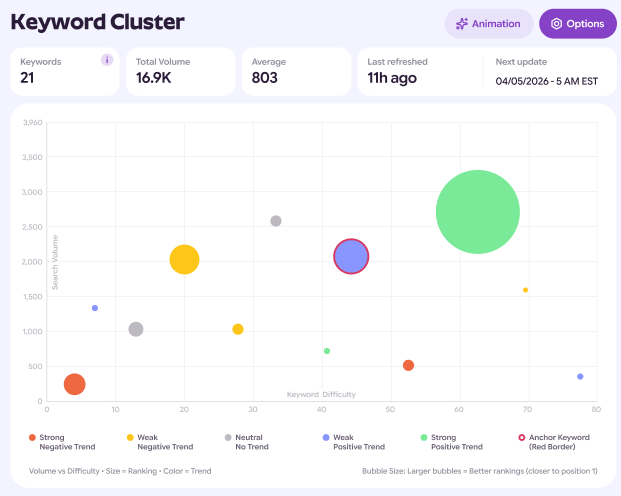
Trend, Similarity & Animation
The true power of this workflow is its ability to generate more high-value keywords within a single, self-contained cluster. Because ClusterView’s AI keyword clustering groups terms by search intent rather than surface-level word matching, it automatically uncovers variations traditional tools miss. This semantic intelligence is exactly why adjacent terms like “realty services” or “full service real estate” were pulled into our main cluster, even though neither phrase explicitly contains the anchor word “estate”.
If you want to scale a cluster even further, you aren’t limited to the initial results. You can easily add extra keywords manually or use AI-assisted suggestions to expand and track new terms. Whether you are injecting known high-performing keywords from historical lists or prompting the AI to mine deeper long-tail opportunities, the tool actively tracks their search volume, keyword difficulty, and ranking performance alongside the rest of your data. This lets you continuously build your cluster without starting a new search from scratch.
Trend Tracking
Flags whether interest in a term is rising, falling, or holding steady. This is incredibly useful in a real estate market where demand for specific services shifts constantly with changing interest rates and economic conditions.
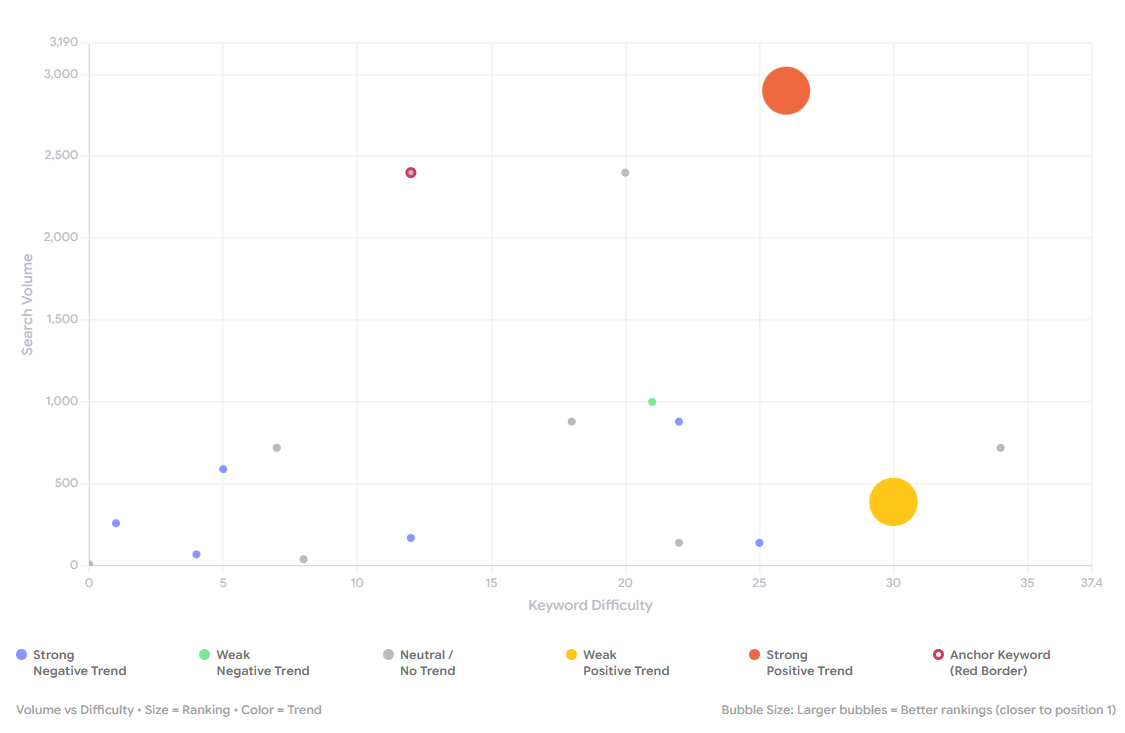
Interactive Keyword Cluster Map (Similarity Scoring)
Built on the same live SERP analysis data behind the cluster, this visually displays how tightly each keyword clusters around your main anchor from lowest to highest. This makes it effortless to spot outliers or content gaps at a single glance rather than reading through endless rows of relevance percentages.
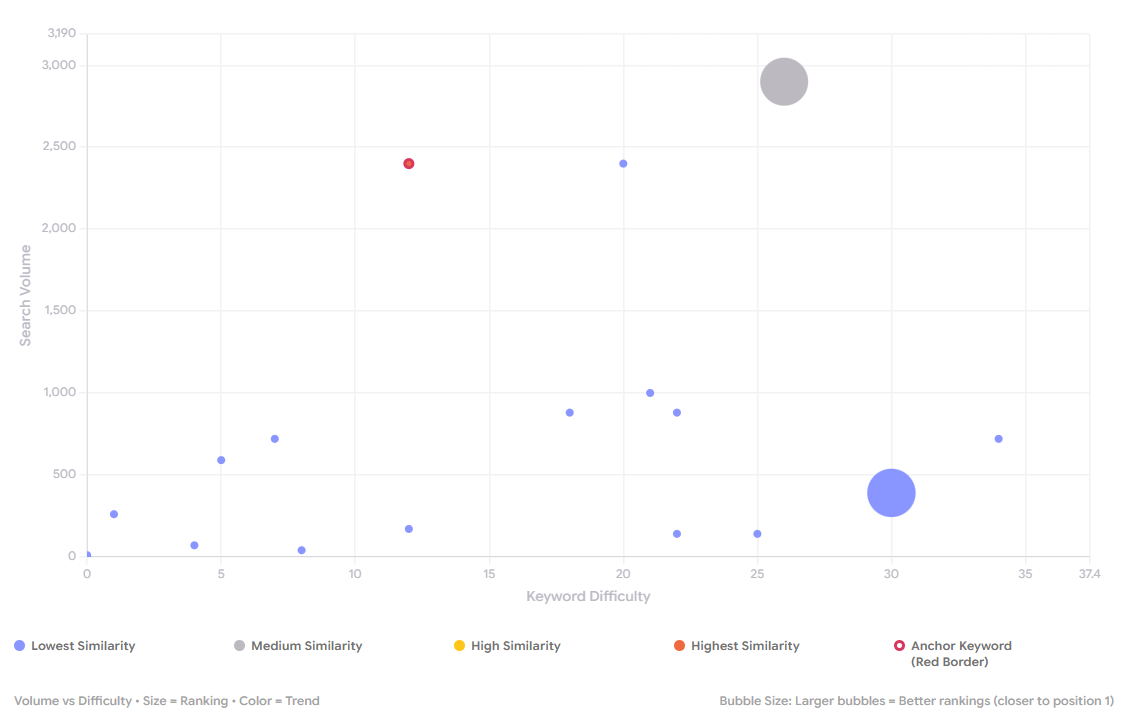
Cluster Movement Animation
For a longer-term view of the market, the Keyword Trends Animation feature steps through your chosen date range. It allows you to watch an entire cluster’s volume, difficulty, and ranking metrics move over weeks or months, giving you a predictive edge rather than forcing you to rely on a single static snapshot.

More ClusterView Features: Turning Data Into Content
The AI Topic Generator
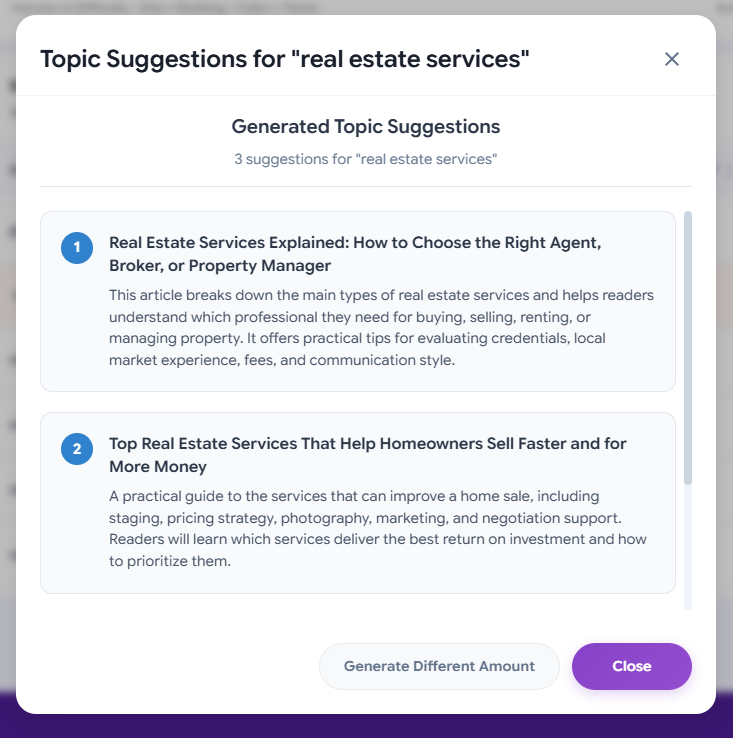
Instead of staring at a blank page or manually brainstorming headlines, you can use the AI Topic Generator to turn your finalized keyword clusters into actionable content ideas.
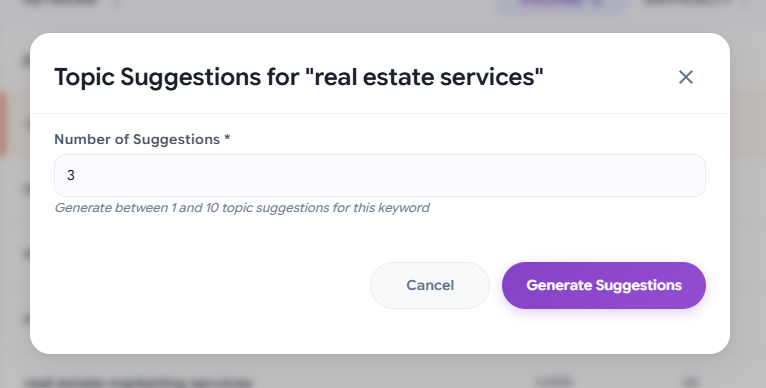
The AI analyzes your cluster structure, identifies your specific topical gaps, and suggests article topics, blog post angles, and content formats that carry a clear, SEO-driven direction. For our real estate services cluster, running the data through this feature instantly returned highly targeted, usable concepts built directly from underlying user intent:
- “Real Estate Services Explained: How to Choose the Right Agent, Broker, or Property Manager”
- “Top Real Estate Services That Help Homeowners Sell Faster and for More Money”
Export, Share, and Customize Your Insights
Once your research is ready, ClusterView makes it simple to save, present, and hand off your data:
- Seamless Export and Download: No rebuilding lists in separate apps. With a clean Export button inside your active workspace, your finalized keyword clusters, volumes, and difficulty metrics export cleanly for immediate sharing with clients, writers, or internal teams.
- Download Visual Charts: Want to include your interactive cluster maps or trend graphs in a presentation deck or external report? You can download and save the visual charts directly from the visualization panel.
- Interactive Chart Customization: Use the Settings toggle in the upper-right corner of the graphic panels to adjust display parameters, filter metrics, and customize exactly how your keyword data is visualized before exporting.
Multi-Domain Support & Collaboration
Beyond turning individual clusters into editorial calendars, the platform scales efficiently across larger business workflows:
- Domain-Based Organization: You can organize your SEO projects cleanly by website. Each domain gets its own dedicated workspace, making it easy for agencies managing multiple clients or companies running several web properties to keep their keyword research segmented.
- Multi-User Collaboration: You can collaborate directly with your marketing and content teams. Multiple users can jump into the same cluster workspace, review real-time keyword metrics, and map out content strategy together without passing cluttered spreadsheets back and forth.
FAQ: Your Questions Answered
Should property management be treated as the same topic as real estate services?
Not quite. Its relevance score against the “real estate services” anchor was meaningfully lower than the rest of this list, which suggests it’s an adjacent but distinct service category, worth its own dedicated content rather than folded into a general real estate services page.
How many of these keywords need their own page?
Not all 15. Several are close enough in intent to live on the same page, “realty services,” “professional real estate services,” and “full service real estate” could realistically be one strong page rather than three thin ones.
Why did some seed keywords not show up at all?
Not every term you try will come back relevant. “Commercial real estate services” and “luxury real estate services” were both tested here and came back too far off-topic to include, which is useful information in itself, it tells you where the real edges of a keyword cluster are.
What’s the difference between keyword grouping and keyword clustering?
In practice, they describe the same underlying process, organizing keywords by shared intent so they can be targeted correctly. Our guide to keyword clustering tools covers this distinction in more depth if you want the full breakdown.

How do I find more keywords like this for my own niche?
Start with a single, specific anchor keyword rather than a broad category, then let relevance scoring filter out noise and trend data tell you what’s worth prioritizing. That’s the entire process behind this article, applied to a new anchor of your choosing.
Final Thoughts
If you work in the real estate industry, in any capacity that involves selling a service rather than a property, these are keywords you should already have somewhere in your website copy, your agent or brokerage profile, or your landing pages. Not necessarily all 15 on one page, but represented somewhere across your site’s structure, in the headlines, service descriptions, and page titles that describe what you actually do.
The businesses that show up for these searches aren’t the ones with the most content. They’re the ones whose content is organized clearly enough, by intent, not just by keyword, for both search engines and AI answer engines to understand exactly what service they’re looking at.
If you want to run your own niche through this same process, ClusterView’s free trial is the fastest way to see it firsthand, or you can reach out to us for any further questions.