
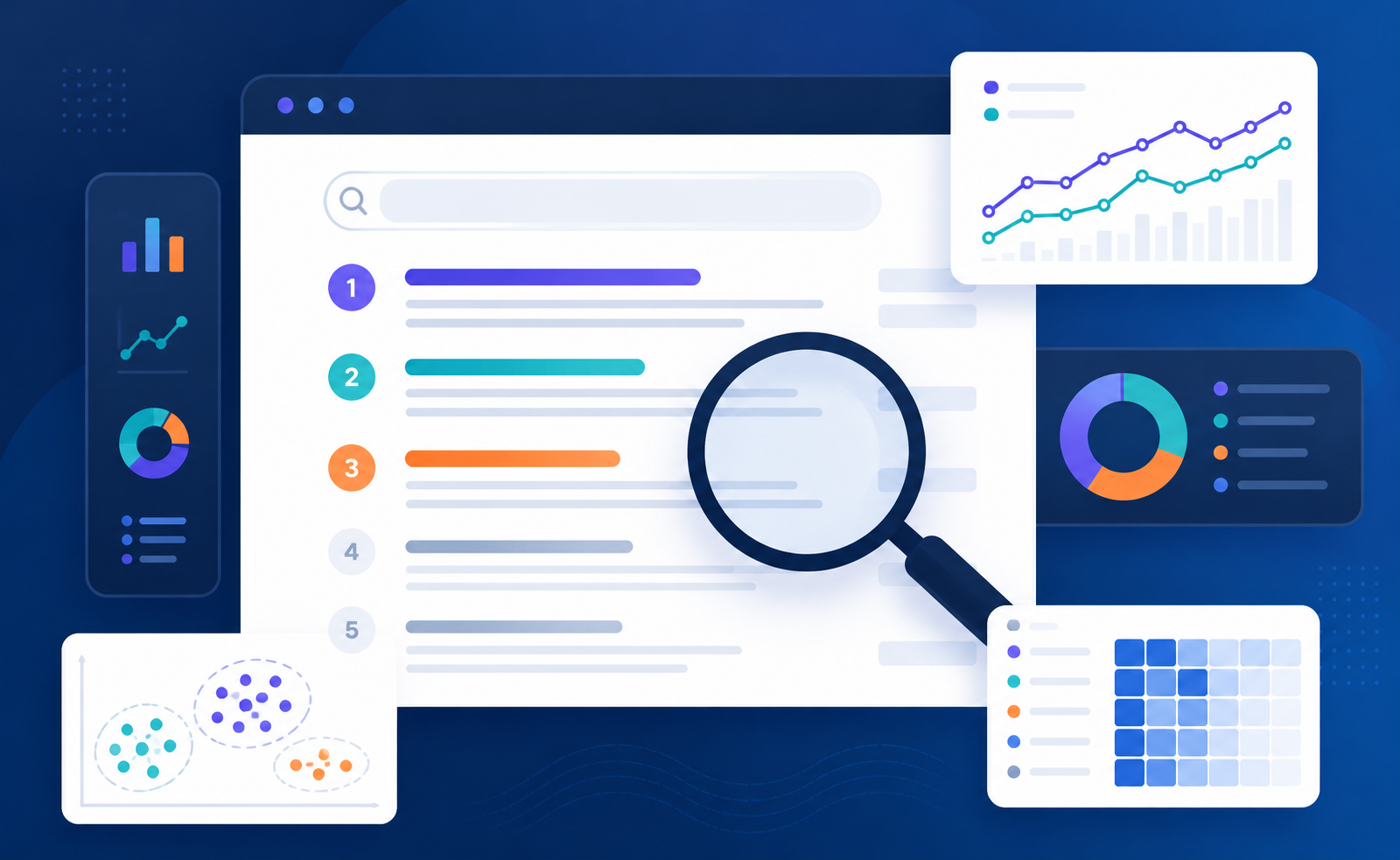
Whenever a user types a query into a search engine, the resulting page one layout is a dynamic environment. It is no longer just a flat list of ten blue links. Modern search engine results pages (SERPs) are highly volatile, shifting rapidly based on local user intent, AI-generated overviews, and interactive shopping carousels.
If you want to claim a spot at the top, you cannot guess what type of content might work. You must reverse-engineer the pages that are already winning. A reliable search results analyzer allows you to dissect your competitors’ structural data, track algorithm shifts, and isolate weak targets.
Here is our breakdown of the 7 best SERP analysis tools to keep your marketing team ahead of search changes.
1. ClusterView
To turn live search dynamics into an actionable content blueprint, ClusterView delivers a highly automated approach. Instead of requiring you to open hundreds of tabs manually to evaluate page layouts, this ai seo software system maps the real-time search engine results directly from your target queries.
By deep-diving into live page layouts, it determines how search engines cluster intent. It lets you know instantly whether a phrase requires a dedicated, independent article or if it can be easily grouped into an existing content asset. It pairs this deep structural overview with a robust rank tracking tool to follow your positioning shifts over time.
- Best For: Automated intent mapping, semantic clustering, and dynamic competitor tracking.
- Pricing: Plans start from $15/month. View current plans.
- Get Started: Ready to master page one? Activate your free Trial to begin auditing real-time search environments instantly.
2. LowFruits
LowFruits is explicitly designed to find weak spots on page one. It analyzes search result variations en masse to look for instances where low-authority forums, user-generated Q&A platforms, or weak subdomains are occupying top rankings.
When it detects these spaces, it marks them as low-hanging fruit, giving smaller websites or new brands an ideal blueprint of terms they can target and win quickly.
- Best For: Finding low-competition keywords and weak page one domains.
3. thruuu
For content writers and editors, thruuu offers an exceptionally granular on-page analysis of search data. This free and premium analyzer scrapes the exact structure of top-ranking pages, outlining their header tags, word counts, image quantities, and core keyword usage.
By giving you a side-by-side comparison of your competitors’ content blueprints, it clarifies exactly what your article needs to look like to meet the algorithmic standard.
- Best For: Competitor outline parsing and deep content structure audits.
4. Mangools SERPChecker
Mangools provides a beautifully clear localized search testing ground through SERPChecker. It allows you to check search layouts across thousands of localized geographic areas down to the specific city level.
Mangools also tracks over 40 technical metrics including domain authority and trust scores, helping you evaluate whether your site has the institutional weight to outpace the current page-one landscape. It fits cleanly into any standard marketing toolkit for small businesses where local market visibility is critical.
- Best For: Hyper-local geographic search testing and clean metric scoring.
5. Ahrefs SERP Checker
Ahrefs offers a free and premium search checking utility powered by its massive web index. Entering a keyword reveals the real-time top organic listings alongside critical backlink data for every single result, including their exact URL Rating and referring domain count.
This tool is highly effective when you want to look past the content format and determine whether a competitor’s position is held up by an aggressive link profile.
- Best For: Evaluating backlink profiles and authority weights on page one.
6. SEMrush SERP Analysis
Semrush handles page analysis by looking closely at search engine layout shifts and algorithmic volatility. Its sensor tool monitors fluctuations across industries, alerting you when an unannounced algorithm update is reshuffling top listings.
This keeps your team proactive, allowing you to quickly spot whether a drop in traffic is a localized problem or part of a broad search engine update. Integrating these regular audits helps you refine your broader agency search framework templates by keeping your tactics aligned with macro industry movements.
- Best For: Tracking market-wide algorithmic volatility and search layout changes.
7. Serpstat SERP Crawler
Serpstat provides an advanced crawling API and analysis setup built for deep data processing. It breaks down the prevalence of unique search engine components, mapping out exactly how many direct answers, images, shopping banners, or map packs are cluttering a specific phrase.
This helps you evaluate the true organic click potential of a keyword before assigning editorial resources to it.
- Best For: Structural data extraction and tracking search layout elements.
Turning SERP Insights into Sustainable Growth
Running a search analysis tool is an essential first step to understanding your competitive arena, but manual execution can easily lead to analytical bottlenecks. Real success requires acting on this competitive intelligence systematically.
Instead of parsing individual listings, your content workflow should rely on a repeatable structure that instantly groups these data signals into a coherent blueprint. Using a professional keyword clustering tool bridges the gap between raw data and live content production. It transforms search results analysis from an irregular manual audit into a scalable growth engine.
If you are ready to automate your search data parsing and accelerate your rankings, we are here to support your team. Review our flexible pricing models or contact us consult with an organic strategy specialist. To begin organizing your terms with automated precision, register for a ClusterView Free Trial right now.
Frequently Asked Questions (FAQs)
Most monitoring software only tracks your flat numerical position. ClusterView monitors the complete architecture of page one, identifying the presence of dynamic components like featured snippets, interactive carousels, or AI summaries so you can optimize your content for actual visible click-through rates.
The software features specialized localized crawling parameters. ClusterView tests your target terms across distinct geographic boundaries down to the city level, giving you an accurate look at how regional intent variations change your competitive environment.
ClusterView eliminates the need to manually audit hundreds of competitor web pages. The platform automatically extracts structural heading tags, keyword frequencies, and metadata configurations directly from winning sites, giving your agency a clear blueprint to build superior content assets.